Functional harmony in music is like a well-organized family gathering, where every chord has a specific role in creating a harmonious atmosphere. It’s all about understanding how different chords relate to one another and work together to establish a sense of order and direction in a piece of music. Each chord has a technical name:
| Chord Degree | Technical Name |
|---|---|
| Chord I | Tonic |
| Chord ii | Supertonic |
| Chord iii | Mediant |
| Chord IV | Subdominant |
| Chord V | Dominant |
| Chord vi | Submediant |
| Chord viiº | Leading Tone |
Primary Chord Functions
The primary chords are I, IV, and V, which are the tonic, subdominant, and dominant.
Although each chord has a technical name, we generally classify them into three categories when describing their function.
These functional terms are also called tonic, subdominant, and dominant! (To confuse things!)
Tonic Function Chords
These serve as a restful point.
Naturally, chord I belong here, but chords ii and iii also provide a somewhat restful quality, placing them in this category.
Dominant Function Chords
The more tense chords, V and viiº, are categorized as “dominant” chords.
These are the more provocative ones!
Subdominant Function Chords
Chords IV and ii fulfil the “subdominant” function. They create a sense of movement away from the tonic. The subdominant chords often serve as a bridge, introducing a feeling of anticipation before the arrival of the dominant chords.
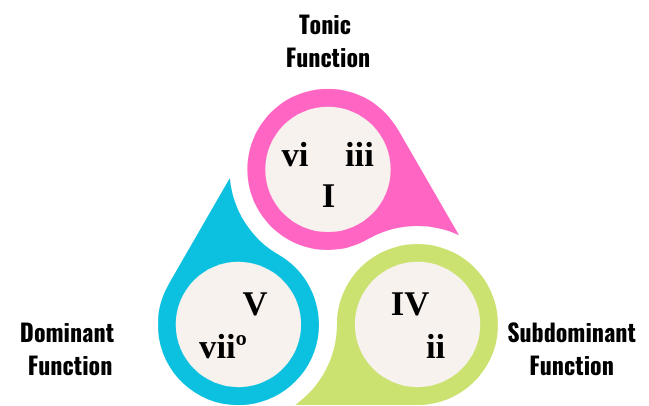
The best way to create solid chord progressions is to move around the groups.
This is why the classic chord progression of I—IV—V—I is so often used and functions so well.
It uses the strongest chord of each group, taking the listener on a satisfying audible journey.
Conversely, a chord progression of I – iii – vi – I is an audible journey to nowhere!
